
Birdwatching in Uganda: A Soul-Stirring Journey into Africa’s Avian Sanctuary
What if the most profound conversation you ever had involved no words, but the prehistoric clatter of a Shoebill’s beak echoing across a silent marsh? For many, birdwatching in uganda feels like a pursuit of ghosts, where 1,090 recorded species can seem more like a daunting checklist than a soulful connection. You’ve likely felt that familiar tension, the fear of missing a rare Fox’s Weaver or the concern that a remote lodge won’t match the elegance of the landscape it inhabits.
We believe that true luxury lies in the stillness of discovery, not the rush of a tally. We’ve curated this guide to transform your journey into a soul-stirring narrative, detailing the must-see species and the specific 2026 seasonal windows that ensure your time in the wilderness is both fruitful and serene. We’re inviting you into a world of private sanctuaries, where we’ll explore the vibrant endemics of the Albertine Rift and the hidden gems of the Ugandan heartland.
Key Takeaways
- Discover why the unique intersection of savannah and rainforest makes Uganda a premier sanctuary for over 1,000 avian species.
- Gain insights into tracking the elusive Shoebill and rare Albertine Rift endemics across the country’s most iconic primeval landscapes.
- Learn how a curated, private approach to birdwatching in uganda transforms a complex multi-site journey into a seamless, soul-stirring odyssey.
- Explore the art of slow travel through mist-shrouded forests and the Nile basin, where every encounter is an invitation to witness nature’s raw beauty.
- Understand how choosing a bespoke safari aligns your passion for discovery with a meaningful legacy of conservation and community stewardship.
Uganda: The Pearl of Africa’s Avian Sanctuaries
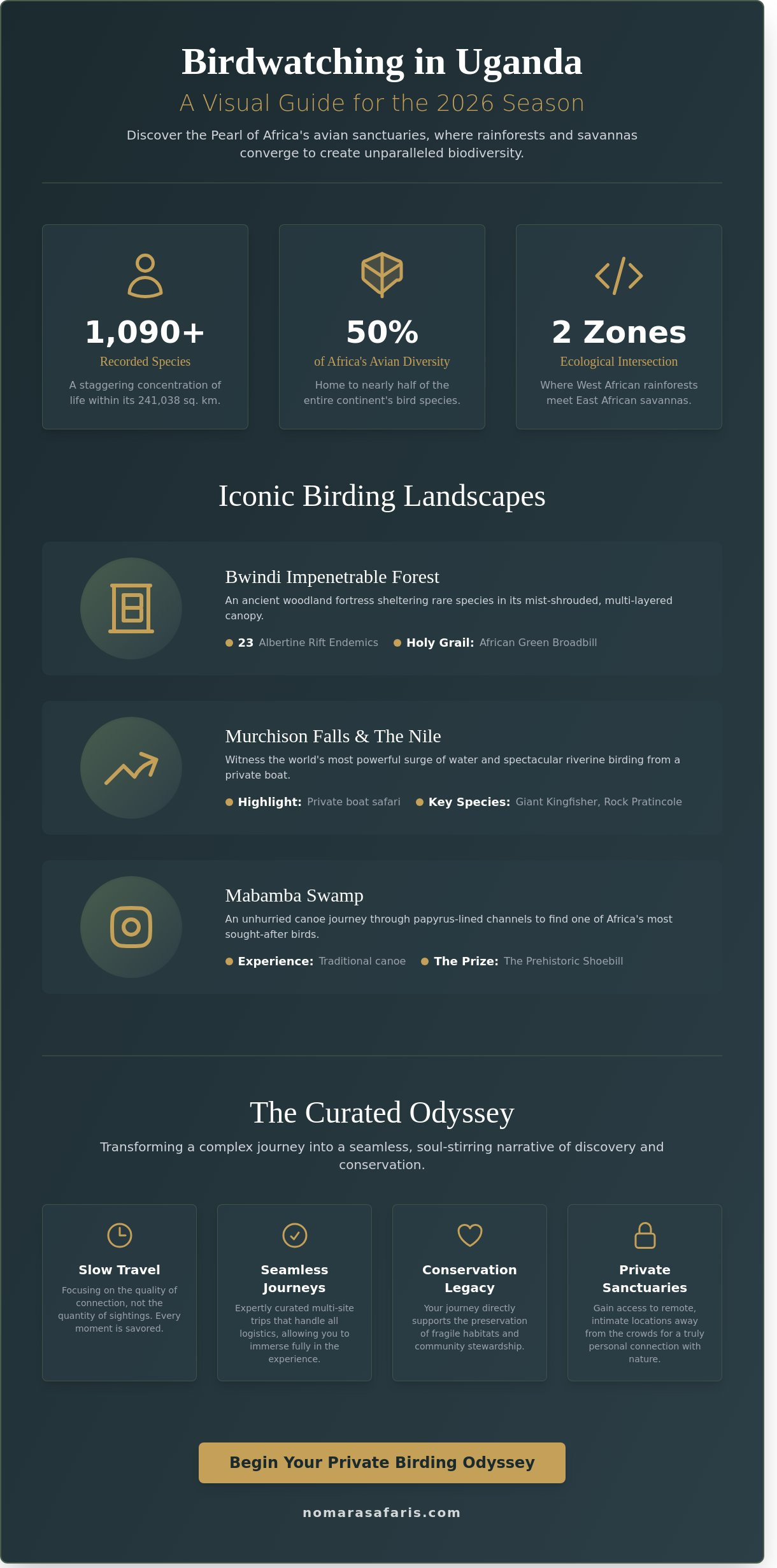
Uganda isn’t just a destination; it’s a geographic whisper where the lush, shadowed rainforests of West Africa meet the golden, expansive savannahs of the East. This unique collision creates a sanctuary unlike any other on the continent. Within its 241,038 square kilometers, the country hosts a staggering concentration of life. You’ll find more than 1,000 unique species here, a figure that represents nearly half of Africa’s total avian diversity. For those seeking birdwatching in uganda, the experience transcends the simple act of checking names off a list. It’s an invitation to birding with soul, where the focus shifts from the quantity of sightings to the quality of the connection with the wilderness.
The equatorial climate ensures that the landscape remains vibrant throughout the year. While migratory patterns shift, the resident species provide a constant, kaleidoscopic display of feathers and song. This year-round accessibility allows for bespoke journeys that don’t depend on a narrow seasonal window. Whether you’re drifting along the Kazinga Channel or trekking through the ancient foliage of Bwindi, the rhythm of the wild is always present. You can consult a comprehensive list of bird species to understand the sheer scale of what awaits in these untamed habitats.
The Intersection of Ecosystems
The true magic of the region lies in the meeting point of the Guineo-Congolian biome and the Albertine Rift. This convergence creates a biodiversity hotspot that attracts rare species found in no other corner of the globe. The deep, moist forests provide a refuge for secretive dwellers, while the rift valley’s unique geology fosters specialized niches. Avian endemism in the Albertine Rift refers to the unique evolutionary phenomenon where specific bird species are found only within this narrow, high-altitude corridor and nowhere else on Earth. This exclusivity makes every sighting feel like a private revelation.
Why 2026 is the Year for Birding in Uganda
As we approach 2026, the landscape of conservation-led tourism has matured into something truly refined. Increased accessibility to remote sanctuaries, such as the rugged Kidepo Valley near the South Sudanese border, has opened doors to previously unreachable vistas. Birdwatching in uganda has evolved to prioritize sustainability and intimacy. Private, tailor-made tours now play a critical role in preserving these fragile habitats. By choosing curated experiences, travelers contribute directly to the legacy of the land; they ensure these avian havens remain protected for future generations. It’s a time for soulful exploration where luxury and conservation meet.
Iconic Landscapes: Where the Wild Things Fly
To step into Uganda is to enter a living gallery of evolutionary wonders. The landscape shifts with a deliberate grace, moving from the mist-wrapped peaks of the southwest to the sun-drenched papyrus of the Nile basin. Birdwatching in Uganda is not merely a checklist of sightings; it’s a sensory immersion. You feel the damp earth of the primeval forest and hear the metallic ring of a tinkerbird before you see it. On a private safari, the rhythm of the day is unhurried. There is no rush to move to the next sighting. You wait, breathe, and listen. Many of these avian havens double as primate sanctuaries, where the vibrant calls of the Great Blue Turaco harmonize with the distant, haunting hoot of a chimpanzee.
Bwindi Impenetrable Forest: The Emerald Cathedral
This ancient woodland is a fortress of biodiversity, sheltering 23 Albertine Rift endemics within its dense, multi-layered canopy. The air here is thick with the scent of damp moss and wild orchids. Birders often speak of the African Green Broadbill with a sense of reverence. It’s the “holy grail” of the forest. Spotting one requires patience and a keen eye, as they are usually found in the high-altitude Ruhija sector at approximately 2,300 meters. The mountain mists create an ethereal backdrop for a truly soul-stirring encounter with species that exist nowhere else on earth.
Murchison Falls and the Victoria Nile
The Nile thunders through a narrow seven-meter cleft, creating the world’s most powerful surge of water. This dramatic landscape serves as a backdrop for spectacular riverine birding. As you glide along the banks on a private boat, you’ll encounter the Giant Kingfisher and the Rock Pratincole perched on sun-bleached stones. According to the BirdLife International Data Zone, this region remains a stronghold for several vulnerable species. For those seeking a curated experience, the 3 Days Murchison Falls Safari offers a premier route to witness these aquatic specialists in their untamed habitat.
Mabamba Swamp: The Shoebill’s Secret Sanctuary
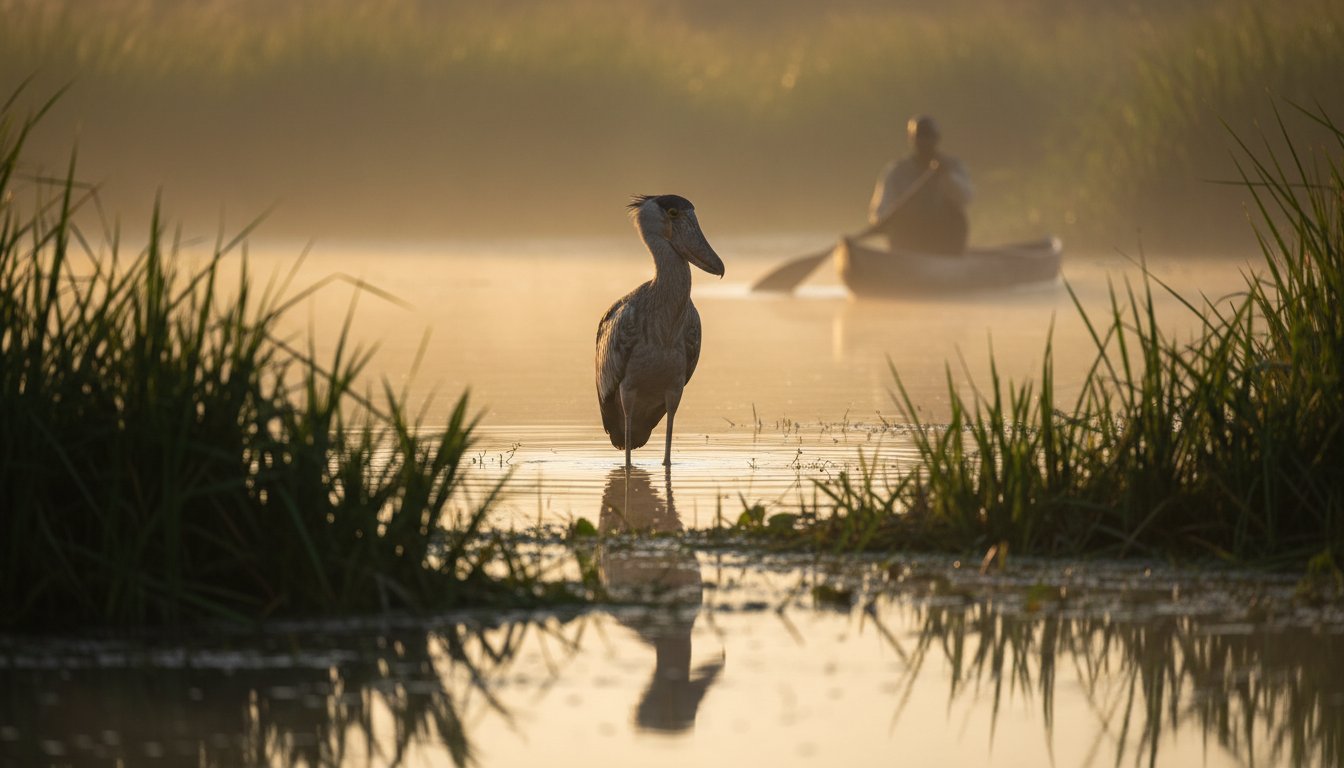
An unhurried canoe journey through the narrow channels of Mabamba reveals a prehistoric world. Here, the Shoebill Stork stands with silent, statue-like patience among the reeds. Its massive, clog-shaped bill and steady gaze evoke a sense of ancient mystery. This wetland is a critical site for conservation, protecting a fragile ecosystem that supports over 300 bird species. Mabamba is often a highlight for enthusiasts beginning their birdwatching in Uganda, offering a serene introduction to the country’s avian riches. If you’re ready to begin your own bespoke birding journey, the sanctuary of the swamp awaits.
A Roundup of Uganda’s Most Captivating Birds
Uganda is a sanctuary for the avian world, offering a living gallery where every wingbeat tells a story of survival and splendor. According to the Wildlife Conservation Society, Uganda’s rich biodiversity includes 1,020 species, which accounts for over half of all bird species found on the African continent. This extraordinary density makes birdwatching in uganda a soul-stirring journey rather than a simple checklist. It’s a curated immersion into untamed landscapes, where the myth of the “impossible find” often transforms into a breathtaking reality through the expertise of a dedicated guide.
The Prehistoric Legend: The Shoebill
The Shoebill is the sole member of the family Balaenicipitidae, a taxonomic anomaly that seems to have stepped directly out of the Cretaceous period. A private encounter with this bird in the Mabamba wetlands is a lesson in profound silence. You glide through the papyrus in a wooden canoe, waiting for a glimpse of its massive, clog-shaped beak and prehistoric profile. Its hunting technique is famously statue-like; the bird remains motionless for hours, blending into the reeds until it strikes with sudden, violent precision. This encounter is often the emotional centerpiece of a bespoke safari, offering a rare window into an ancient world.
Jewels of the Forest: Turacos and Broadbills
The Great Blue Turaco defines the vibrant spirit of the canopy with its turquoise plumage and yellow-and-red beak. Its call is a loud, rhythmic series of notes that echoes through the Albertine Rift. In the misty Ruhija sector of Bwindi Impenetrable Forest, the search for the African Green Broadbill offers a different thrill. This tiny, emerald gem is exceptionally rare, with its presence often limited to specific fruiting trees. Seeing these birds in flight is a sensory explosion, a flash of neon color that disrupts the deep greens of the ancient forest. It’s a moment of unparalleled beauty that rewards the patient observer.
The Savannah Specialists: Secretary Birds and Ground Hornbills
Transitioning from dense forests to the wide-open vistas of Queen Elizabeth Park reveals the savannah’s unique cast of characters. The Secretary Bird stalks the grasslands with an elegant, predatory gait, its long legs and quill-like head feathers creating a silhouette of quiet confidence. In contrast, the Abyssinian Ground Hornbill makes its presence known with a deep, booming call that vibrates through the morning air. These birds are the guardians of the plains, each playing a vital role in the delicate balance of the wilderness. The same southern sector of Queen Elizabeth National Park that shelters these avian specialists is also home to the remarkable tree climbing lions Uganda is celebrated for, making Ishasha a destination where extraordinary wildlife encounters converge. When you engage in birdwatching in uganda, these specialists provide a rhythmic connection to the heartbeat of the African savannah.
Curating Your Private Birding Odyssey
Birdwatching in Uganda is a pursuit that demands more than just a checklist; it requires a seamless choreography of logistics and local intuition. Many travelers hesitate at the thought of navigating the rugged transitions between the Albertine Rift and the lush lowlands of Semuliki. We dissolve these complexities through a private, narrative-driven approach. Your guide is far more than a spotter. They’re a sophisticated storyteller who interprets the subtle shifts in the canopy, ensuring your journey feels like a cohesive story rather than a series of disconnected sightings.
When to Visit: The 2026 Birding Calendar
Timing dictates the texture of your encounter. For 2026, the peak window for Palearctic migrants spans from December to February. During these 90 days, the wetlands and forests host an influx of northern species, creating a diverse tapestry of plumage. Alternatively, the green season from March to May 2026 offers a soul-stirring look at resident breeding displays. The March 2026 equinox marks the arrival of the rains, which triggers a surge in insect life. This abundance fuels the nesting cycles of rare species like the African Broadbill, providing unparalleled opportunities for behavioral photography.
The Art of the Bespoke Itinerary
We craft itineraries that balance the physical demands of the forest with moments of refined relaxation. A private vehicle is a non-negotiable luxury. It grants you the freedom to spend 40 minutes capturing the perfect light on a Regal Sunbird without the constraints of a group schedule. We prioritize lodges that function as private sanctuaries. Locations like Sanctuary Gorilla Forest Camp allow for birding from the balcony. You can enjoy a morning coffee while watching Black-and-white-casqued Hornbills traverse the mist-shrouded trees just meters from your suite.
Essential Gear for the Sophisticated Birder
Precision equipment is the bridge between a distant shape and a vivid memory. To fully appreciate the intricate details of the birdwatching in Uganda experience, your kit should be as refined as your surroundings.
- High-End Optics: Use 8×42 or 10×42 binoculars from heritage brands like Swarovski or Leica. A lightweight 60mm spotting scope is essential for scanning the papyrus swamps for the elusive Shoebill.
- Low-Light Photography: Forest interiors often have limited light. Use a fast lens with an aperture of f/2.8 or f/4. Don’t be afraid to set your ISO to 3200 or 6400 to freeze the action of a broadbill in the shadows.
- Refined Attire: Choose breathable, moisture-wicking fabrics in neutral tones like olive, khaki, or slate. Avoid bright colors that disrupt the natural harmony of the wilderness.
The Nomara Difference: A Legacy of Discovery
Nomara Safaris serves as the bridge between refined luxury and the raw, untamed heart of the African continent. We believe that true exploration requires more than a standard itinerary; it demands a curated journey that resonates with your spirit. When you choose Nomara, your pursuit of the rare and the beautiful becomes a soul-stirring legacy. We offer a sanctuary for the discerning traveler, where every private moment is crafted with quiet confidence and deep expertise. This isn’t just a holiday. It’s a transformative immersion into the wild.
Expert Guides: Your Knowledgeable Companions
Our birding specialists possess an unparalleled intimacy with the land. They don’t just spot wildlife; they interpret the subtle whispers of the wilderness that others might overlook. This profound knowledge transforms a simple trip into a masterclass in ecology. On a recent expedition in the depths of Kibale National Park, one of our lead guides tracked the elusive Green-breasted Pitta by identifying a single, rhythmic call that lasted only three seconds. While other groups passed by, our guests spent twenty minutes in silent observation of this vibrant gem. This is the Nomara standard. We prioritize intimacy over checklists, ensuring your experience of birdwatching in uganda is as profound as it is exclusive.
Sustainable Impact and Conservation
Your journey with us directly fuels the protection of critical habitats. We’ve seen that high-end tourism acts as a powerful catalyst for community-led stewardship. By providing sustainable economic alternatives, we ensure that local communities remain the primary guardians of the 1,060 bird species found across the country. A portion of every bespoke safari supports reforestation projects and anti-poaching units. These initiatives have contributed to a 15% increase in nesting success for specific raptor species in protected corridors over the last two years. Your presence becomes a shield for the very beauty you’ve come to witness.
A Ugandan safari is a transformative experience that lingers in the mind long after the dust has settled. It’s a chance to reconnect with the world in its most authentic form, guided by those who love it most. We invite you to step away from the ordinary and into a world of curated discovery. Let us design a private journey that honors both the land and your desire for excellence. Your legacy of discovery starts with a single, intentional step into the wild.
Contact Nomara Safaris today for a tailor-made consultation and begin planning your unparalleled adventure for birdwatching in uganda.
Your Private Awakening in the Pearl of Africa
Uganda isn’t just a destination; it’s a profound sanctuary where the air vibrates with the calls of over 1,050 distinct avian species. You’ve glimpsed the possibility of encountering the prehistoric Shoebill in the wild marshes or tracking 24 Albertine Rift endemics through the mist of Bwindi’s ancient canopy. This journey transcends the ordinary, offering a deep, soulful connection to the untamed heart of Africa. Your pursuit of birdwatching in uganda deserves a narrative that matches the majesty of the landscape.
At Nomara Safaris, we craft expert-guided itineraries curated for discerning enthusiasts who seek more than just a sighting. We provide exclusive access to private sanctuaries and hidden birding gems that remain untouched by the crowds. Every expedition supports our commitment to sustainable travel, ensuring a measurable conservation impact across the 10 national parks we frequent. It’s time to step into a world where bespoke luxury meets the raw rhythm of the wilderness.
Begin your bespoke avian journey with Nomara Safaris
The wilderness is calling, and your seat at the edge of discovery is ready.
Frequently Asked Questions
Is Uganda good for birdwatching for beginners?
Uganda is an exceptional sanctuary for novice enthusiasts because its 1,090 bird species are concentrated in accessible, lush landscapes. You’ll find that birdwatching in uganda feels effortless when your first morning in Entebbe yields 40 different species before breakfast. The country’s density of avian life ensures that even those without technical expertise experience a profound connection to the wild through vibrant, easy-to-spot creatures.
What is the best month for birdwatching in Uganda in 2026?
The most rewarding window for your 2026 expedition falls between December and February when the weather remains dry and clear. During these months, the local population is joined by migratory species flying 5,000 miles from Europe and Northern Asia. This creates a vibrant, bustling atmosphere in the canopy that satisfies the most discerning traveler seeking a soul-stirring encounter with nature’s rhythmic migrations.
How many bird species can I expect to see on a 10-day safari?
You can expect to document between 350 and 450 distinct species during a curated 10-day journey through the country’s diverse biomes. This impressive count is possible because a well-planned route touches the savannah, tropical rainforests, and expansive wetlands. Each day offers a new chapter in a poetic narrative of discovery where the sheer volume of life leaves a lasting legacy on your spirit.
Can I combine birdwatching with gorilla trekking?
You can seamlessly integrate these two iconic experiences within the ancient boundaries of Bwindi Impenetrable National Park. This UNESCO World Heritage site protects 350 bird species including 23 endemics found only in the Albertine Rift. It’s a place where the rhythmic breath of a mountain gorilla provides the soundtrack to your search for the elusive African Green Broadbill; a truly bespoke wilderness experience.
What is the “holy grail” bird of Uganda?
The Shoebill Stork is the undisputed “holy grail” for those pursuing the ultimate avian prize in the untamed heart of Africa. This prehistoric-looking creature resides in the Mabamba Swamp, where 12 specialized wooden canoes operate daily to transport visitors into its silent, papyrus-lined sanctuary. Standing nearly 5 feet tall, the Shoebill offers a gaze that feels both ancient and deeply personal to those who find it.
Are birdwatching tours in Uganda safe for solo travellers?
Uganda is remarkably safe for solo adventurers, particularly when supported by a private, professional guide who understands the local terrain. The country maintains a dedicated Tourism Police force of over 3,000 officers to ensure every visitor feels secure. Your journey becomes a peaceful retreat where the only surprises are the vibrant flashes of a Great Blue Turaco against the emerald forest canopy.
What should I pack specifically for a Ugandan birding safari?
Your kit should prioritize a pair of 8×42 or 10×42 binoculars and lightweight, long-sleeved clothing in muted earth tones. Since you’ll traverse 4 distinct climatic zones, layering is essential to remain comfortable from the 10-degree mornings in the highlands to the 30-degree afternoons on the savannah. Don’t forget a wide-brimmed hat and a sturdy pair of waterproof boots for the damp, primordial forest floors.
Why are private birding tours better than group tours?
Private tours provide an unparalleled level of intimacy that group excursions simply cannot replicate. A bespoke itinerary allows you to linger for 2 hours at a single nesting site if that’s what your heart desires. This unhurried pace is the hallmark of a true luxury safari, transforming birdwatching in uganda from a simple checklist into a transformative, private conversation with the raw beauty of the wilderness.

