
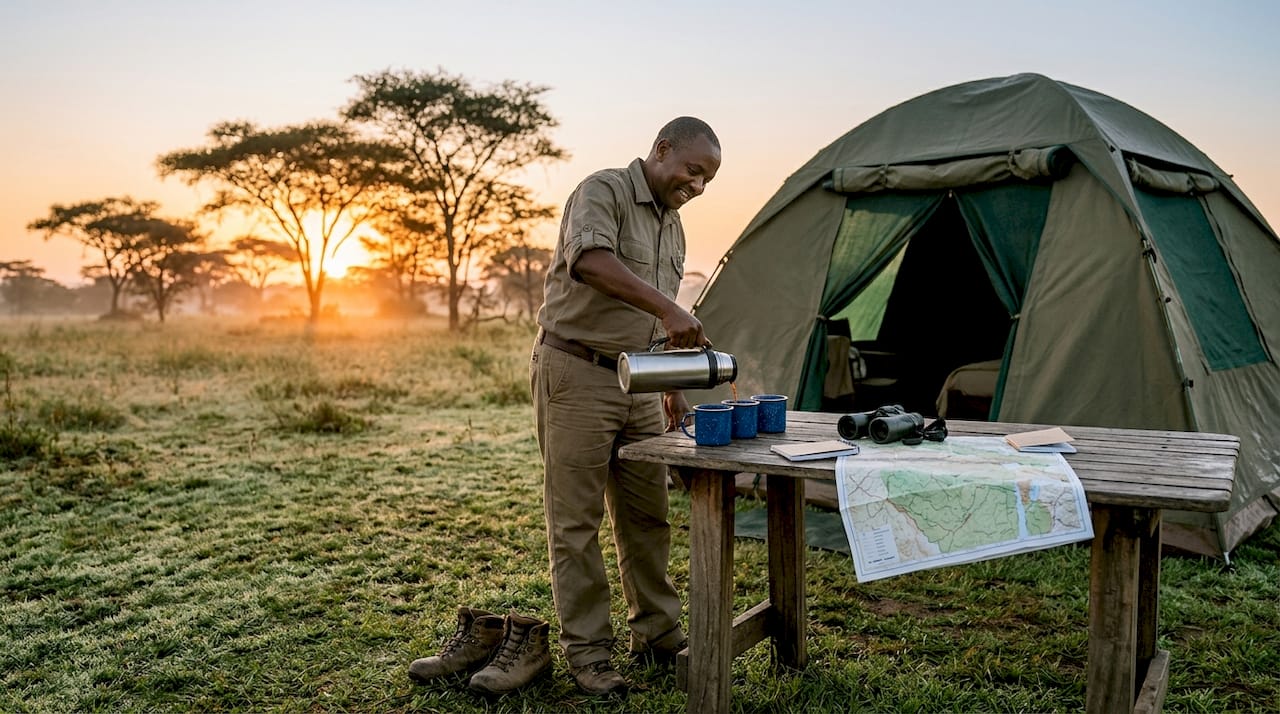
Booking safaris early : luxury and personalization await
Luxury safari lodges and in-demand guides are often booked many months in advance, and that single fact changes everything about how you should plan your trip. East Africa’s most coveted camps, private conservancies, and exclusive wildlife experiences operate on strictly limited capacity. There is no waiting list that magically opens up. If you are dreaming of watching the Great Migration from a private tented camp on the Mara River, or spending a morning with mountain gorillas in Bwindi Impenetrable Forest, the clock starts ticking the moment you start imagining it. This guide breaks down exactly why booking early is the single most important decision you will make for a truly extraordinary safari.
Table of Contents
- The realities of safari demand and availability
- What you gain by booking early: Perks and access
- Risks of waiting: What late bookers miss out on
- When and how to book: Expert timelines and tips
- Why the best safari experiences reward those who plan ahead
- Book your East Africa safari with Nomara Safaris
- Frequently asked questions
Key Takeaways
| Point | Details |
|---|---|
| Prime experiences go fast | Luxury lodges, top guides, and unique permits are snapped up months in advance. |
| Early booking saves money | Planning ahead locks in better rates and secures promotions unavailable later. |
| Personalization is key | Tailor-made itineraries and private perks are easier to arrange with advanced notice. |
| Expert help matters | Partnering with pros leads to seamless planning and once-in-a-lifetime safari moments. |
The realities of safari demand and availability
East Africa’s safari industry runs on scarcity. That is not a marketing tactic. It is the structural reality of a region where the best lodges hold fewer than 20 guests at a time, and where wildlife permits are issued by government agencies with fixed daily quotas. Understanding this supply-demand dynamic is the first step toward securing the safari you actually want.
Demand spikes are predictable and intense. The Great Migration in Kenya and Tanzania draws travelers from July through October. School holidays in Europe and America flood the market every summer and over the December festive period. Even shoulder seasons like January and February are increasingly popular as travelers seek fewer crowds. Prime safari lodges in Kenya and Tanzania are often booked 12 to 18 months in advance for peak season. That is not an exaggeration.
Here is a quick look at how availability shrinks as departure dates approach:
| Months before travel | Typical availability at top lodges | Permit access |
|---|---|---|
| 18+ months | Excellent, full choice | Readily available |
| 12 months | Good, some dates filling | Limited for peak dates |
| 6 months | Restricted, waitlists forming | Scarce for gorilla trekking |
| 3 months or less | Very limited or sold out | Largely unavailable |
Boutique lodges and private conservancies are the most affected. A camp with eight tents that sells out for July and August by the previous September simply has nothing left to offer you in March. This is not about budget. Even the most affluent traveler cannot buy a room that does not exist.
✔ Key availability pressures to know:
- Migration season (July to October) fills first, often 12 to 18 months out
- Gorilla trekking permits in Uganda and Rwanda are capped daily by national park authorities
- Private vehicle game drives require early lodge booking to guarantee exclusivity
- Specialist guides with strong reputations are booked independently and fill up fast
Exploring the full range of luxury safari types early gives you a clearer picture of what you want and how far ahead you need to plan. Some unique safari activities like walking safaris, fly camping, or night drives also have limited slots per property.
The bottom line is simple. Supply is fixed. Demand is growing. Waiting is a losing strategy.
What you gain by booking Safaris early: Perks and access
Demand drives scarcity, but what do you tangibly gain by booking before others? Quite a lot, as it turns out. Early booking is not just about avoiding disappointment. It actively unlocks a better safari in almost every measurable way.
Choice of accommodation is the biggest win. When you book 12 to 18 months out, you can select the exact camp, the specific tent or suite, and the precise dates that suit your travel style. You are not choosing from leftovers. You are building your experience from scratch.

Early bookers are more likely to secure exclusive-use properties, star guides, and limited-access permits such as gorilla trekking. That access is genuinely transformative. A renowned naturalist guide does not just point out animals. They read animal behavior, anticipate movement, and turn a game drive into a masterclass in wildlife ecology.
✔ What early booking unlocks:
- Your preferred lodge, villa, or tented camp on your preferred dates
- Exclusive-use options for families or private groups
- Renowned naturalist guides with deep regional expertise
- Gorilla trekking and chimpanzee habituation permits
- Custom itinerary design with time to refine every detail
- Early booking promotions on select safari itineraries
“The best safari experiences are built over months of careful planning, not assembled in a hurry. When you book early, you are investing in the quality of every single moment.”
Pro Tip: Ask your safari planner about exclusive-use camp buyouts if you are traveling with a group of six or more. These options disappear earliest and offer unmatched privacy and flexibility.
There is also a financial case for booking safaris early. Some lodges and operators offer early booking rates or added-value inclusions like complimentary bush walks, spa treatments, or airport transfers. These are rarely available to late bookers, who often pay a premium for whatever remains. Connecting with top safari guides early means you can align your itinerary with their availability rather than compromising.
Personalization is the final and perhaps most underrated benefit. A tailor-made safari built 15 months out can incorporate your specific interests, whether that is big cat photography, birding, or a cultural immersion with local communities. That level of detail takes time to design well.
Risks of waiting: What late bookers miss out on
The advantages of booking safaris early are clear, but what exactly happens when travelers procrastinate? The consequences are real and they compound quickly.
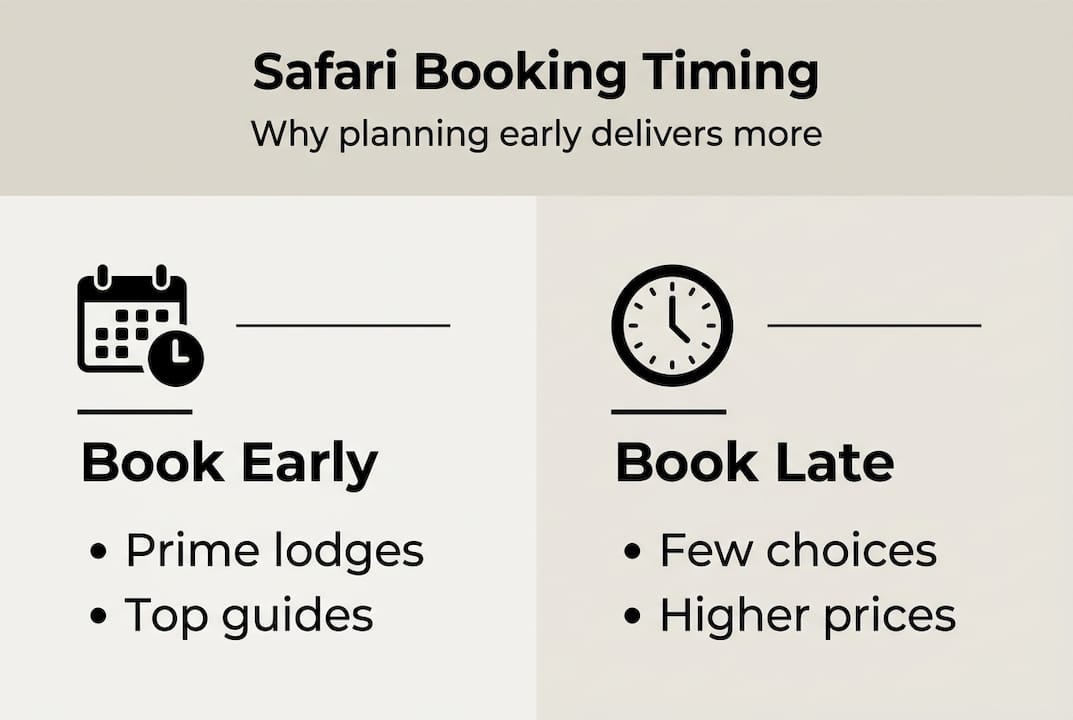
Late planning often results in higher flight costs, second-rate lodges, and loss of premium guide options. Here is how early and late bookings compare across the key factors:
| Factor | Early booker (12-18 months out) | Late booker (3 months or less) |
|---|---|---|
| Lodge selection | Full range, best suites available | Limited to unsold inventory |
| Guide quality | Top-rated naturalists available | Generalist guides only |
| Permits | Secured for preferred dates | Largely unavailable |
| Pricing | Standard or discounted rates | Premium or surge pricing |
| Itinerary | Fully customized | Restricted by availability |
| Flight options | More routes, better prices | Expensive, limited routing |
Here is what the experience looks like in practice for a late booker:
- You settle for a lodge you did not choose. The camps you researched are full. You end up at a property that is fine but not exceptional.
- Your guide is assigned, not selected. Without early coordination, you get whoever is available rather than a specialist matched to your interests.
- Key activities are off the table. Gorilla trekking permits, private conservancy access, and specialty game drives are gone.
- You pay more for less. Flights booked within 90 days of travel to East Africa are significantly more expensive, and lodges rarely discount last-minute inventory.
- Personalization disappears. There is simply not enough time to design a safari around your specific preferences.
Pro Tip: If you are already within six months of your intended travel dates, focus on our best-selling safari trips first. These are designed to deliver exceptional experiences even when planning time is shorter.
The emotional cost matters too. Luxury travelers expect a seamless, curated experience. Scrambling to piece together a safari at the last minute introduces stress, compromise, and a nagging sense that something better was possible.
When and how to book: Expert timelines and tips
Knowing what is at stake, let’s get practical. Here is when and how to secure your dream safari based on the type of experience you want. Optimal booking windows range from 9 to 18 months before travel, depending on season and exclusivity. Use this as your planning framework:
✔ Recommended booking timelines by experience type:
- Great Migration (Kenya/Tanzania), July to October: Book 15 to 18 months in advance
- Gorilla trekking (Uganda/Rwanda): Book 15 to 18 months in advance; permits are the binding constraint
- Peak holiday travel (December/January): Book 12 to 15 months in advance
- Shoulder season safaris (February to March, November): Book 9 to 12 months in advance
- Low season travel (April to June): Book 6 to 9 months in advance for best lodge selection
Here is a step-by-step process to get started:
- Define your vision. Decide on the countries, experiences, and travel style before reaching out to a planner. Kenya, Uganda, Tanzania, Rwanda, and Zanzibar each offer distinct experiences.
- Contact a safari specialist early. A good planner will hold tentative reservations while you finalize decisions, often at no cost.
- Secure permits first. Gorilla trekking and chimpanzee habituation permits are the most time-sensitive element of any itinerary. Lock these in before anything else.
- Book flights as soon as your safari dates are confirmed. International routes to Nairobi, Entebbe, and Kilimanjaro fill up fast during peak periods.
- Refine your itinerary over time. Booking safaris early gives you months to personalize activities, dining preferences, and special touches.
Browsing seasonal safari experiences gives you a solid starting point for matching your travel dates to the best wildlife events. If you are still deciding on the right format, exploring planning a safari trip helps clarify the options available to you.
Why the best safari experiences reward those who plan ahead
Here is a candid view from our experience working with travelers across Europe and America: the idea of last-minute luxury in East Africa is largely a myth. It works in some parts of the world. It does not work here.
The travelers who have the most extraordinary safaris are not the ones with the biggest budgets. They are the ones who planned with intention, often a year or more before departure. They chose their lodge because it matched their vision, not because it was the only option left. They spent mornings with a guide who knew their interests before they even arrived. They sat at a riverbank watching wildebeest cross because their camp was positioned perfectly, not because they got lucky.
True luxury in East Africa is built on access, personalization, and anticipation. It begins the moment you commit to the journey, not the moment you board the plane. Custom safari trips designed well in advance reflect a traveler’s personality in ways that last-minute bookings simply cannot replicate.
Our honest advice: treat the planning process as part of the experience itself. The excitement of designing your itinerary, selecting your camp, and knowing your permits are secured is genuinely part of what makes a safari unforgettable.
Book your East Africa safari with Nomara Safaris
Ready to unlock the safari you have always imagined? Early planning is where the magic starts, and we are here to make it effortless.
At Nomara Safaris, we specialize in building tailor-made East Africa itineraries that secure the best lodges, guides, and permits well before they disappear. Whether you are drawn to the drama of Kenya’s wildlife landscapes or the rare intimacy of Uganda gorilla trekking, our team handles every detail with precision and care. 👉 Start your planning conversation today. The earlier you reach out, the more extraordinary your safari can be. Secure your spot now and experience East Africa the way it was meant to be seen.
Frequently asked questions
How far in advance should I book a luxury safari in East Africa?
Optimal booking windows range from 9 to 18 months before travel, depending on the season and experience type. For peak seasons and ultra-exclusive experiences, plan to book at least 12 to 18 months ahead.
What benefits do early bookers get compared to last-minute planners?
Early bookers are more likely to secure exclusive-use properties, star guides, and limited-access permits. You also get better rates, more personalization options, and a fully customized itinerary built around your interests.
Are there risks to booking a safari late?
Late planning often results in higher flight costs, second-rate lodges, and loss of premium guide options. You also lose the ability to personalize your experience and may miss out on key activities entirely.
Is booking safaris early recommended for gorilla trekking permits?
Absolutely. Gorilla trekking permits in Uganda and Rwanda are strictly capped by national park authorities, and early bookers secure permits for bucket-list activities like gorilla trekking far more reliably. Plan 15 to 18 months ahead, especially for peak travel periods.
