
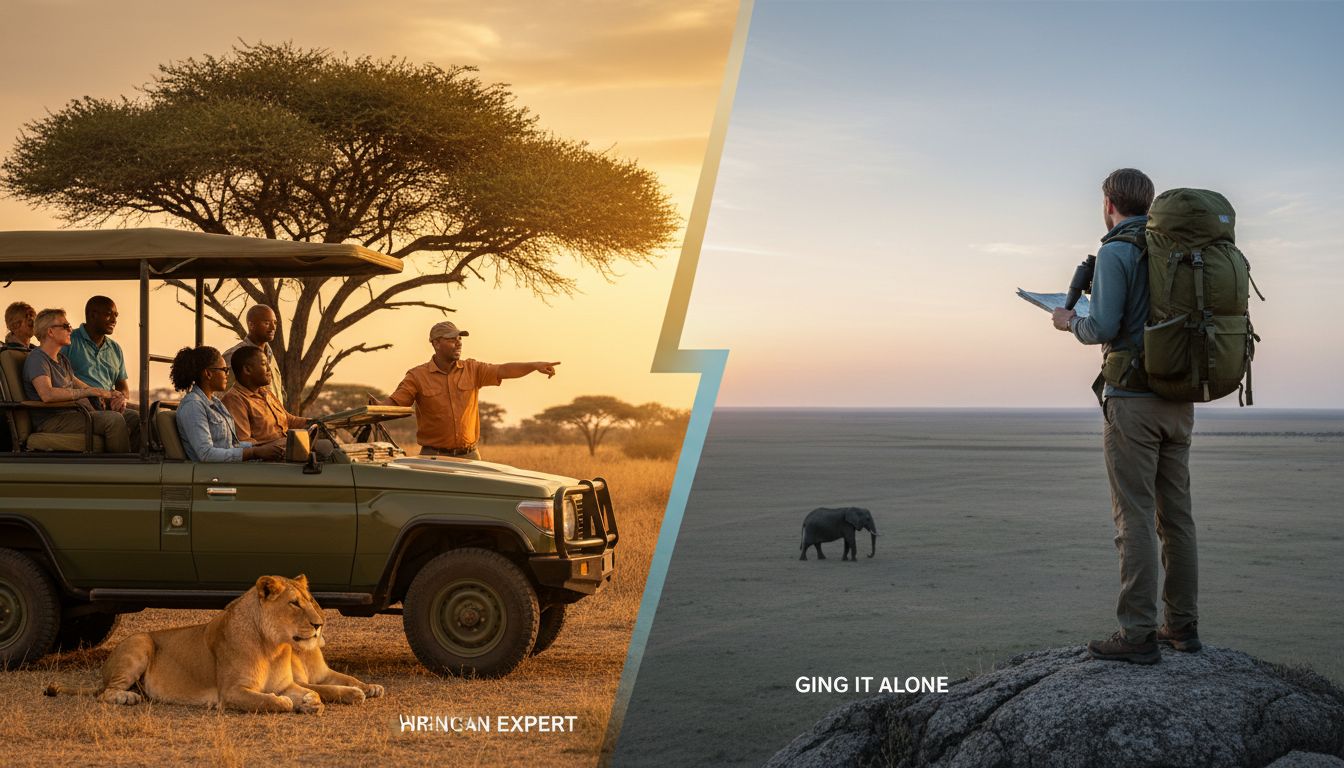
Planning an African wildlife journey in 2026 often comes down to one practical question: should you handle everything yourself, or should you bring in a specialist? The answer is rarely ideological. It is structural. In the safari specialist vs DIY safari debate, the best choice depends less on your appetite for adventure and more on how many moving parts your itinerary contains, how costly a mistake would be, and whether the destination itself is forgiving. For affluent travelers considering East Africa in particular, that distinction matters enormously.
There are trips that lend themselves beautifully to independent planning, and there are trips where expert support is not a luxury add-on but a form of risk management. A South Africa self-drive through Kruger can be relatively transparent, with public rates, standardized camps, and direct online booking through SANParks. By contrast, a tailor-made East or Central African itinerary may involve changing park fees, internal flights, border rules, permits, conservation levies, and camp-specific terms that do not reveal their complexity until after you have paid. In other words, safari specialist vs DIY safari is not just about convenience. It is about choosing the right planning model for the journey you actually want.
Start with the structure of the trip, not the romance of independence
The cleanest way to think about safari specialist vs DIY safari is to ask whether your journey is simple or compound. A simple trip is one country, one park system, one hire car, one set of entry rules, and accommodation that can be booked directly with clear pricing. A compound trip layers domestic flights, meet-and-assist services, permit inventory, multiple parks, cross-border timings, and accommodation with different inclusion models. Once those layers begin to stack up, the value of professional support rises quickly.
This is why the 2026 reality check matters. DIY remains easiest in South Africa, where SANParks publishes rates and fees directly, including current conservation-fee periods through 31 October 2026. That level of public transparency reduces the informational advantage of an intermediary for travelers who are comfortable comparing camps, planning routes, and booking in time. In the safari specialist vs DIY safari conversation, South Africa remains the strongest argument for going alone if you are organized and realistic.
East and Central Africa are different. Kenya, Tanzania, Uganda, and Rwanda often involve more fragmented pricing and more itinerary dependency. A single routing choice can affect park fees, transfer timing, and whether your camp location aligns with your game-viewing goals. That is why safari specialist vs DIY safari cannot be answered with a blanket rule. It has to be answered by looking at geography, logistics, and consequence.
When going it alone makes perfect sense
There are absolutely moments when DIY is the smart, elegant choice. If you are planning a classic self-drive wildlife holiday rather than a bespoke safari circuit, independent booking can work beautifully. Kruger is the obvious example. Current SANParks information shows an international conservation fee of R602 per adult per day for the tariff period from 1 November 2025 to 31 October 2026, and the park’s systems are built around direct public bookings. Roads are navigable, camps are established, and pricing is visible enough that disciplined travelers can plan with confidence.
That transparency changes the safari specialist vs DIY safari calculation. If you enjoy spreadsheets, are happy to compare room categories and cancellation terms, and do not mind managing your own pace, a self-drive in South Africa may not need expert handling. The destination itself is forgiving. There is less hidden choreography than on a fly-in East African itinerary, and a missed detail is less likely to collapse the entire trip. DIY also works well when you are flexible on dates and can chase shoulder-season value, long-stay discounts, or late-opening inventory yourself.
Another reason to go alone is price clarity. Some travelers genuinely prefer seeing every line item for themselves rather than paying for packaged convenience. In a safari specialist vs DIY safari comparison, DIY can suit those who want maximum control over accommodation choices, driving distances, daily rhythm, and budget trade-offs. If your trip is structurally simple and the destination publishes its rates openly, independent planning can be both satisfying and financially sensible.
When scarce permits make expert help the wiser choice
If your trip depends on limited permits, the safari specialist vs DIY safari decision shifts decisively toward expert support. Gorilla trekking is the clearest example. Rwanda’s gorilla permit remains widely cited at USD 1,500 per person in 2026, and peak dry-season dates are commonly advised to be booked months in advance. When one sold-out permit can derail flights, lodge nights, and onward touring, this is no longer a casual admin task. It is the spine of the itinerary.
Uganda and Rwanda itineraries also expose a common weakness in DIY planning: people book the attractive parts first and only later discover that the permit date, transfer length, or border sequence does not actually work. In the safari specialist vs DIY safari debate, permits create an asymmetric risk. If you make a small error on a self-drive hotel stop, you can often recover. If you mismatch a gorilla permit, your entire journey may need to be rebuilt at far greater cost.
Scarce inventory matters beyond gorillas too. Fixed migration windows, highly sought-after camps, specialist photography departures, and private guiding slots all create timing pressure. If your travel dates are immovable because of honeymoons, school breaks, or milestone celebrations, expert handling becomes more valuable. In safari specialist vs DIY safari terms, fixed dates plus scarce inventory is one of the strongest indicators that you should not leave the planning to chance.
Why East Africa often rewards specialist planning
Luxury East African safaris are wonderful precisely because they are layered. You might combine the Masai Mara with the Serengeti, add a few nights in Rwanda or Uganda, then finish on Zanzibar. It sounds seamless in a brochure, but the practical reality includes park fees, internal flights, vehicle logistics, luggage restrictions, seasonal weather, and camp-by-camp inclusion differences. This is where safari specialist vs DIY safari becomes less a philosophical debate and more a question of operational fluency.
Fee complexity is a major reason. Tanzania’s TANAPA tariff schedule was updated in February 2026, and Kenya park pricing has also shifted in recent cycles. The line rate is not always the real rate. There can be ranger fees, vehicle fees, concession charges, timing rules, and premium surcharges that materially affect total cost. The Masai Mara is a useful example: current 2025-2026 summaries show expensive non-resident pricing and a 12-hour or 24-hour structure depending on where and how you stay. If you are combining Mara sectors, camps, and transfers, mistakes matter.
In the safari specialist vs DIY safari comparison, this is exactly where a seasoned operator earns their keep. Not by doing what Google can do, but by understanding how the pieces behave together. A specialist may stop you from pairing the wrong airstrip with the wrong camp, from paying for a park-entry pattern that is poor value, or from selecting a routing that looks efficient on a map but wastes prime game-viewing time. In East Africa, smart planning is often invisible only because someone experienced has already solved the problems.
Flights, baggage rules, and the hidden fragility of fly-in safaris
Once your safari includes flights between camps, safari specialist vs DIY safari usually tilts toward hiring help. Fly-in itineraries in remote Tanzania, Botswana, Zambia, or Zimbabwe are less forgiving than road-based holidays. Light aircraft often come with strict baggage limits, soft-bag requirements, and timing that must align closely with camp transfer operations. A beautiful itinerary can become stressful very quickly if one detail is off.
Many travelers underestimate how interconnected these logistics are. Your outbound luggage choice may affect whether you can board as planned. Your choice of camp can determine your transfer chain. A weather delay can ripple into missed activities or overnight repositioning costs. In the safari specialist vs DIY safari context, these are not theoretical inconveniences. They are common pressure points on higher-end itineraries where every day is expensive and every connection matters.
Specialists are especially valuable here because they know which routes are robust and which are merely possible. They also tend to know where timing buffers are prudent and where they are unnecessary. That judgment is difficult to replicate from websites alone. If your safari involves bush flights, meet-and-assist arrivals, multiple camps, or remote concessions, safari specialist vs DIY safari is not a close contest. This is precisely the sort of trip where expertise protects both your investment and your peace of mind.
Health, insurance, and why remote travel changes the equation
Health preparation is one of the most overlooked parts of the safari specialist vs DIY safari question. The CDC’s 2026 Yellow Book advises safari travelers to consult a travel-medicine specialist for the latest yellow fever information and notes that medical evacuation from a resource-poor area might be necessary. That phrase matters. A medevac is not a dramatic edge case in the imagination of cautious travelers; it is a real planning consideration in remote safari regions.
If your itinerary includes malaria zones, isolated conservancies, multiple countries, or long overland sectors, the consequences of complacency increase. In safari specialist vs DIY safari terms, health is often the point where independent travelers realize that “booking a trip” and “engineering a safe trip” are not the same thing. Insurance wording, evacuation cover, entry-health rules, and access to care can all matter more than the room category you choose.
A good specialist does not replace medical advice, of course, but they can design an itinerary that is more realistic and better supported. They can also flag where route choices, seasonality, and remoteness alter your risk profile. If you are planning a once-in-a-lifetime journey with a high spend and limited vacation time, safari specialist vs DIY safari should include a sober look at what happens when something does not go to plan. That is where expert support often proves its value fastest.
Families, photographers, and special-interest travelers have more to lose
Not every traveler is equally well served by a DIY model. Couples on a simple self-drive can often absorb minor errors. Families with children, multigenerational groups, and travelers with special interests usually cannot. In the safari specialist vs DIY safari debate, complexity rises sharply when camps have different child policies, age thresholds, family-room rules, and activity restrictions. What looks like a straightforward booking can become expensive if one lodge does not allow younger children on walks or if room configurations do not match your family structure.
Photographers and wildlife enthusiasts also benefit disproportionately from specialist planning. This is not because they cannot book a room themselves, but because their goals are more precise. They may need the right habitat at the right time, a camp with strong guiding, specialist vehicles, or access to particular experiences such as rhino tracking, private vehicle use, community visits, or hosted conservation departures. In safari specialist vs DIY safari terms, the more specific your ambition, the more useful a specialist becomes.
Budget control is also more nuanced than many assume. Recent Tanzania rate sheets list walking safaris at $120 per person and hot-air balloon safaris at $659 per person in some Serengeti products. Extras like these can shift a safari budget quickly beyond room rates alone. A specialist can explain what is worth adding, what can be skipped, and what should be bundled from the outset. In a safari specialist vs DIY safari comparison, avoiding costly mismatch is often more valuable than finding a nominally cheaper line rate.
Entry rules, fine print, and the cost of administrative mistakes
One of the clearest signs you should hire help is uncertainty about entry rules. Kenya’s eTA requirements remain official and dynamic enough that even government-linked guidance advises travelers to use official Government of Kenya channels for the latest visa and eTA information. If your itinerary spans multiple countries, the safari specialist vs DIY safari decision should include an honest assessment of how much rule-checking you are willing to do yourself, and how confident you are that you will keep checking as your departure date approaches.
The same applies to booking terms. Recent operator documentation shows how widely fine print can vary: consultant fees, deposit schedules, forfeiture rules, insurance requirements, conservation levies, and park-fee exclusions are not standardized across the industry. In the safari specialist vs DIY safari discussion, this is where many experienced travelers quietly admit that they do not want another hobby. They do not want to decode which camp includes drinks, laundry, game drives, transfers, or conservation fees and which one excludes them.
This is also why the phrase “preventing expensive misunderstandings” is such a useful lens. A good specialist is not merely finding animals on your behalf. They are reducing the odds that you arrive with the wrong expectations, the wrong permit date, or the wrong assumptions about what you have paid for. In safari specialist vs DIY safari terms, administration may not be glamorous, but it is often where money is won or lost.
How to decide in 2026: a practical rule for real travelers
If you want a concise rule, here it is: go alone for South Africa-style self-drive wildlife holidays with published public pricing and direct booking systems; hire an expert for East and Central Africa if your plan includes scarce permits, several parks or countries, flight logistics, children, fixed dates, or a budget level where mistakes would be painful. That is the most useful safari specialist vs DIY safari rule for 2026, and it reflects how the region actually works rather than how travel content likes to simplify it.
Repeat safari-goers are often better candidates for DIY than first-timers. That is not gatekeeping; it is pattern recognition. Even safari planning materials aimed at consumers acknowledge the reality. As one planning guide puts it, “There is so much to consider when planning a safari.” Marketing line or not, it is directionally true. In safari specialist vs DIY safari terms, confidence should come from understanding the system, not from underestimating it.
There is also the question of conservation impact. Some current safari products explicitly tie bookings to community or wildlife contributions. One example states, “Each booking provides a USD 2,000 donation” to support a lion boma project. If those claims matter to you, safari specialist vs DIY safari should include a quality check on what impact language really means. A specialist can help verify which camps and experiences have tangible conservation value and which simply market the idea attractively.
Ultimately, safari specialist vs DIY safari is not a contest between authenticity and convenience. It is a decision about matching the planning method to the complexity of the trip. If your route is straightforward, your dates are flexible, and the destination publishes pricing clearly, independent travel can be rewarding and entirely sensible. If your journey is permit-heavy, multi-country, fly-in, family-focused, or once-in-a-lifetime in budget and emotional significance, expert guidance is usually the smarter form of luxury.
The warm truth is that there is no virtue in making safari travel harder than it needs to be. Some travelers genuinely enjoy the research and control of doing it all themselves. Others would rather spend their energy anticipating the first lion sighting at dawn than decoding tariffs, transfer timings, and baggage rules. Choose the model that protects the experience you are investing in. In the safari specialist vs DIY safari debate, the best answer is the one that leaves you free to travel with confidence.

